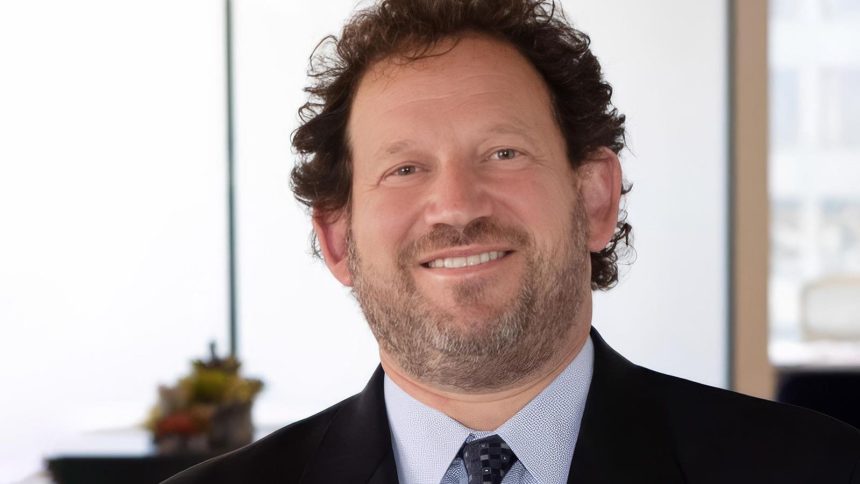
Like other value investing stalwarts, $35 billion Hotchkis & Wiley made its name filling its funds with cheap, unloved stocks. Here’s how manager David Green is keeping the old-school philosophy alive in a market dominated by a handful of AI giants.
Ina market obsessed with artificial intelligence, longtime portfolio manager David Green is leaning the other way. His $767 million Hotchkis & Wiley Value Opportunities Fund (HWAIX) has become a kind of anti-AI trade, hunting for mispriced companies, big and small, that investors have abandoned in favor of the AI boom. That contrarian stance—rooted in Hotchkis & Wiley’s 45-year value discipline—is holding its own while tech-heavy indexes continue to log impressive returns.
Green has been quietly loading up on unglamorous companies investors have decided aren’t beneficiaries of the AI boom—such as software maker Workday, telecom-equipment giant Ericsson, and moving-and-storage giant U-Haul. The common theme in all three holdings: Dominant competitive positions, strong balance sheets and valuations beaten down in a lofty market. “There’s been a real gravitation toward a small group of high-flying stocks,” says Green. “That creates opportunities elsewhere.”
It’s an approach that fits squarely into the culture and history of Hotchkis & Wiley, a Los Angeles–based asset manager founded in 1980 by John Hotchkis and George Wiley. Their original philosophy—buy good companies at low valuations and let time do the work—still defines the firm today. Hotchkis, a co-founder of L.A. asset management giant Trust Company of the West, and Wiley, a stock broker who was a founding investor of pension consulting firm Callan Associates, built their investment firm around the idea that valuation discipline, deep research and intellectual debate could consistently beat markets. Merrill Lynch acquired the the firm for $200 million in 1996, but mismanaged it and eventually sold it to back its managers including Wiley’s daughter Gail Bardin, who retired in 2004. During the Merrill turmoil, Hotchkiss’ daughter, Sarah Ketterer, left to co-found Causeway Capital in 2001, another value investing outfit, which now has $67 billion in assets.
Forty-five years after its founding, its value-investing DNA is still intact. Roughly half the firm’s 77 employees work on the research side, and hiring into that team remains fiercely competitive. Green joined the firm in 1997 after stints at Prudential and Goldman Sachs Asset Management. In 2001, he was part of the group of partners that bought back the firm and took it private. Assets under management have climbed from $4 billion at the time of the buyout to about $35 billion today.
Green is a manager on the firm’s Small Cap Value, International Value and its Value Opportunities, which launched at the end of 2002. Value Opportunities, an all-cap go-anywhere strategy with anywhere between 40 to 70 holdings, has performed the best. Since inception, the fund’s Institutional share class has returned 12.5% annualized, beating its benchmark, the Russell 3000 Value Index, by about three percentage points and besting the S&P 500’s annual return of 9.6% over the same period. Most of the fund’s investors have been funneled into it via various financial advisors and brokerage firms like Edward D. Jones and Schwab, where the sales charge may be waived.
The top ten positions in Green’s fund, including Workday, SLB Ltd. (formerly known as Schlumberger), F5, Inc. and Havas NV, account for roughly 45% of assets, and turnover averages 76%, reflecting a habit of leaning into volatility—adding when sentiment collapses and trimming when valuations run ahead of fundamentals.
So far 2025 has been challenging. The fund is up 9.7% year-to-date, trailing the S&P 500’s AI-supercharged 15.3% return. Unbothered Green argues that narrow markets eventually broaden—and disciplined value investors are typically well-positioned when they do.
Green’s valuation lens starts with enterprise value to sales, but the most important metric is enterprise value to operating income (EV/EBIT), paired with a long-term view of how that operating income can grow. “A low multiple doesn’t matter if earnings are shrinking,” says Green. “We want cheap companies where the underlying business is stable or improving.”
His largest holding, at 8% of his portfolio, is Workday, the enterprise-software maker and cloud-based platform used by roughly hundreds of large companies to manage everything from HR functions like payroll to financial processes like accounting. The market views Workday as an anti-AI story—exposed to corporate headcount, potentially vulnerable to new competitors using generative AI to write software more cheaply. Shares have fallen 11% in 2025.
“What looks like a competitive threat may actually be additional business,” says Green, adding that AI may be a powerful tool, but replicating the complexity, compliance requirements and integration depth of Workday’s platform—embedded inside the workflows of global corporations—is far harder than investors assume. With churn below 2% and a high percentage of recurring revenue, Workday behaves more like infrastructure than a trendy tech stock. Today it trades around five times enterprise value to sales, a level Green notes is closer to where private-equity buyers acquire inferior software companies. “For a dominant, established firm, the valuation compensates more than enough for the risks,” he adds.
A similar logic applies to global telecom-equipment leader Ericsson, another top holding, based in Sweden with roughly $24 billion in annual revenue. It trades around 1.1× enterprise value to sales, and management has targeted 15–18% operating margins, implying roughly six times EV/operating income—a low valuation for a global leader in a market likely to grow as mobile data consumption accelerates. “All else equal,” says Green, “if you can buy the leading company with the best technology at a good valuation, that’s attractive.”
If Workday represents misunderstood tech and Ericsson discounted global infrastructure, Reno, NV-based U-Haul is Green’s most classic value play—dominant market share, high brand recognition, and temporarily depressed earnings. The $5.6 billion revenues company dominates the DIY moving market and with more than 24,000 locations worldwide, has more outposts than McDonald’s or Starbucks. U-Haul has a market cap of only $9 billion with shares down nearly 30% in 2025 alone. It is roughly 10 times larger than its nearest competitor, Penske. Green especially likes U-Haul’s expansion into self-storage, a business with high margins and minimal maintenance. “Whenever somebody drives one of their trucks on the freeway, people drive by and go, ‘Oh, there’s a U-Haul,’” says Green. “That’s free advertising.”
Green sees opportunity from three temporary headwinds that have weighed on current earnings: Elevated depreciation after buying trucks at peak Covid prices, early-stage losses from a rapidly expanding self-storage business that takes years to fully lease, and temporarily low domestic mobility due to high mortgage rates. Adjust for those factors, Green argues, and U-Haul trades at less than 9x “normal” earnings—an appealing entry point for a franchise with unmatched scale.
Looking ahead, Green’s macro view is restrained: “Expect more modest, historically normal returns,” he says. “There seem to be two different markets: an AI market that is booming, and a broader economy that is a bit weaker.”
As for AI itself, Green is neither a skeptic nor a true believer. “AI is definitely real and game-changing,” he says. “But I haven’t yet seen the return on investment that will be necessary to justify the level of spending we’re seeing.” In the meantime, he’s content to buy the companies the AI mania forgot—and let the rest of the market catch up later.
More from Forbes
Read the full article here