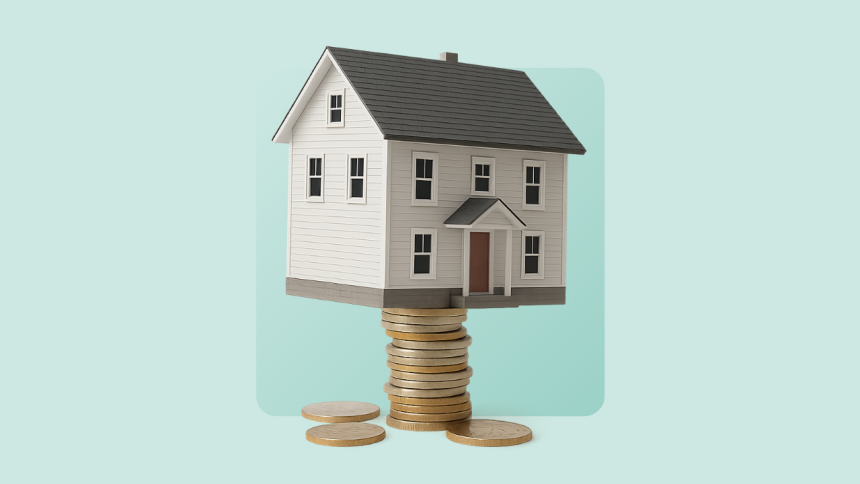
For years, the real estate industry has advised prospective homebuyers to cross off their list any home that would require them to spend more than 30% of their income on mortgage payments and other fees.
That rule no longer seems to work in much of the country, thanks to the post-pandemic jump in home prices and mortgage rates.
A Bankrate analysis shows that the typical U.S. household needs to spend 43% of its income to buy a median-priced home of $435,000. As a result, many homebuyers are stretching their budgets further than they should to snatch their piece of the American Dream.
“It’s hard to stay under 30% now, but that doesn’t mean that people should just disregard it completely,” said Chen Zhao, head of economics research at Redfin. “And if people are finding it difficult to adhere, they should consider their options. Could it make sense to rent? Does it make sense to move to a lower cost-of-living area?
If you do spend more than 30% on housing, where are you cutting back?
— Chen Zhao, head of economics research at Redfin
The trade-offs that once came with pushing beyond 30% have grown steeper, forcing many households to make more difficult choices about where and how they live, according to Theresa Green, a mortgage broker in Charlotte, N.C. It often entails bigger financial and lifestyle sacrifices, compromising on the kind of home to buy and staying in the home longer to make the upfront investment worthwhile, she said.
“It’s totally changed since COVID,” Green said. “Before COVID, buyers were very much more in line with that 30% rule. Many, many, many times it’s gonna be above that now. I honestly see very few that are below that.”
The housing rule that once defined affordability no longer adds up
If you want to buy a house today, it’ll require a much larger slice of your income than it did just a few years ago.
It’s a harsh reality that Allison Dunbar, a product development coordinator in Pittsburgh, and her husband learned firsthand when they began their home search at the end of 2022. When Dunbar compared her experience to that of her oldest brother, who bought his home before the pandemic, the difference was staggering.
“He bought his house in Pittsburgh in 2018, and he got a very nice house in a nice area that fits his family now for $20,000 under the posted price,” Dunbar said. “That is not a thing in Pittsburgh anymore.”
According to Bankrate’s analysis of housing market data, Pittsburgh is one of only three large metro areas where typical households can still keep housing costs below the 30% affordability benchmark. The other two are Detroit and St. Louis. These statistics were derived from a separate analysis of home prices by Bankrate that found that three out of four homes on the U.S. market are unaffordable to the typical household.
In most of the largest U.S. metro areas, it’s common for new homeowners to go beyond that benchmark. In coastal markets like San Francisco, Los Angeles, Miami and New York, the typical household in these areas would need to devote two-thirds or more of their income to afford a median-priced home.
New Orleans, Seattle and Boston aren’t far behind, hovering near 50%, according to Bankrate’s analysis, while Southern markets like Charlotte, Atlanta and Houston remain somewhat more attainable. Even in those areas, a typical household would need to spend 30% to 40% of their income to afford the typical home.
That 30% rule is meant to cover more than just a monthly mortgage payment. It also includes property taxes, home insurance and, in some cases, homeowners association fees. Take New Orleans, for example: a median-priced home costs nearly $281,000.
With a 20% down payment and today’s sub-6% mortgage rates, the monthly principal and interest alone would top $1,500 – roughly in line with the 30% rule for a typical New Orleans household earning $62,000. But once you add property taxes and home insurance, the total jumps to more than $2,500 a month, pushing the payment beyond what’s considered affordable for the area.
“The 30% rule matters more when money is tight,” said Hannah Jones, senior economic research analyst at Realtor.com. “For wealthier households, housing can take up a larger share of income without necessarily compromising their ability to meet other needs or save for the future.”
Wages have lagged while home prices and mortgage rates soared
The barriers to homeownership go beyond high prices and mortgage rates. Household incomes also haven’t kept pace, lagging behind the pandemic-era surge in home prices and the rise in mortgage rates that followed.
To afford a median-priced home in the U.S., a household would need to make roughly $113,000 a year, according to Bankrate’s calculations. In 2020, roughly $78,000 per year could secure the typical home.
Research shows average home prices are up roughly 50% across the country since 2020, while wages have lagged, growing only 22% since the start of 2021, according to Bankrate’s analysis of Bureau of Labor Statistics data.
Wages are slowly catching up more this year, according to Jones, but not nearly fast enough to bridge the distance between what families earn and what many markets demand.
“ Wages have not kept up with home price growth when you’re thinking over the last five years,” Jones said. “If you’re thinking over the last year, then there are markets where home prices have softened and wages continue to climb.”
The widening gap between pay and home prices has upended traditional measures of affordability and forced buyers to adjust their expectations in recent years.
If the 30% rule doesn’t work, what replaces it?
Even as home prices in some markets cool from pandemic highs, that hasn’t translated into meaningful relief for prospective homebuyers.
“Buyers are gaining a little bit of ground,” Jones said. “But they’re digging themselves a little bit out of a very deep trench at this point.”
Home prices remain stubbornly high, mortgage rates are still hovering near two-decade highs and the supply of homes for sale is historically low. Combined, those forces have locked many current homeowners in place and kept would-be homeowners renting as they wait for affordability to improve.
Kelley King, a real estate agent in Charlotte, has seen how hard it is for homebuyers to stomach the jump in monthly payments that comes with owning nowadays.
“There’s an initial shock going from renting to owning,” King said. “ I have a client right now who wants to buy their first home, and they are currently paying around $1,900 in rent. If they were to purchase a house, their monthly payment for housing would go to $3,300. It’s a very large jump, but you also have to remember you’re building equity for yourself.”
Some housing experts argue that instead of treating the 30% rule as a strict cutoff, households should think of it more as a benchmark that depends heavily on income level.
For low- and middle-income households, the 30% rule is a useful target because these families typically have limited discretionary income. If housing costs rise much above 30%, it can become difficult to afford essentials without financial strain. For higher-income households, exceeding the 30% threshold may not create the same financial pressure.
— Hannah Jones, Senior economic research analyst at Realtor.com
Green said the 30% rule shouldn’t be followed too rigidly, since every buyer’s financial situation and spending habits are different. Someone who tends to spend more might need to stay closer to the rule, while a more frugal buyer could likely afford to stretch a bit further, she said.
“ I would hate for somebody to rule themselves out,” Green said. “They need to talk to an experienced loan officer who can run those scenarios based on what their life situation is. We never want to see more than 50% of your gross income going out the door for the house.”
Once buyers have a realistic all-in number, Jones recommends evaluating how much remains for everyday necessities, long-term savings goals and inevitable surprises.
“In the end, affordability hinges on whether your lifestyle and savings plans can be maintained sustainably while still leaving a cushion for unexpected costs,” Jones said.
There may no longer be a simple formula for what Americans can afford, but the goal of owning a home hasn’t disappeared. For many, that now means buying later, moving farther or making other financial sacrifices while they wait for the math to check out.
The 30% rule may be more challenging, but the dream of owning a home – even if it costs more – isn’t going anywhere.
Why we ask for feedback
Your feedback helps us improve our content and services. It takes less than a minute to
complete.
Your responses are anonymous and will only be used for improving our website.
Help us improve our content
Read the full article here